
The Language of Food: Reimagining Community Engagement
Health engagement often happens at a distance from the people it aims to serve. We noticed that when communities are asked to change how they eat, the ask typically comes wrapped in universal health language that erases the particular ways food carries culture, memory, and family. We wondered: what if we worked in the opposite direction? What if the cooking itself became the method?
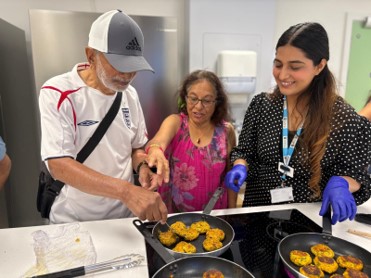
Roots to Recipe emerged from this question, funded through the LIAS Leicester, Leicestershire and Rutland scheme. We organised five cooking workshops, each focused on a different community’s food traditions. Participants learned to create healthier versions of their own familiar dishes, guided by someone from their community who understood the cultural significance of the food. Community champions were present at each session not to lead, but to provide trusted presence, cultural grounding, and to help bridge conversations. Their role was critical: they ensured people felt safe, heard, and that their food traditions were valued.
What happened was unexpected in its ordinariness. When food conversations unfolded in the languages people speak at home, when the recipes belonged to their own traditions, when the person teaching had walked the same streets and understood their food not as data but as lived practice something shifted. People came, learned, and brought others back.
The waiting lists told us something important. So did the comments people noticed when they were listened to, when their knowledge was treated as knowledge rather than as something needing correction. They noticed the recipes came in their languages. They noticed. These aren’t small things. They’re the baseline of engagement that deserves the name.
We learned that whoever leads the conversation shapes what becomes visible. When community members share knowledge rooted in how their families cook and eat, the conversation becomes less about changing behaviour and more about honouring what people already understand. The knowledge was already there. We just made space to work with it rather than against it.
LIAS’s support enabled us to treat Roots to Recipe not as a one-off community activity but as a meaningful model for engagement. We’re thinking differently now about what counts as community partnership. Multilingual materials matter, but so does showing up in spaces people already inhabit. Professional facilitation matters, but so does the trusted presence of people who have lived within a community for decades. Both are necessary. Neither alone is sufficient.
If what we understand community health to be emerges from where and how and with whom we have conversations about it, then the design of those conversations their language, their location, whose voice carries weight is engagement design. Roots to Recipe is our attempt to be intentional about that.
Hansika Bansla, Research Assistant. Diabetes Research Centre. Division of Global, Lifestyle and Metabolic Health. e: hb424@leicester.ac.uk
University of Leicester | University Road | Leicester | LE1 7RH | UK